

Summary
The real history of the 1934 National Firearms Act — passed after the crime wave ended, voted on by voice vote only, and built on a constitutional workaround the Attorney General admitted under oath.
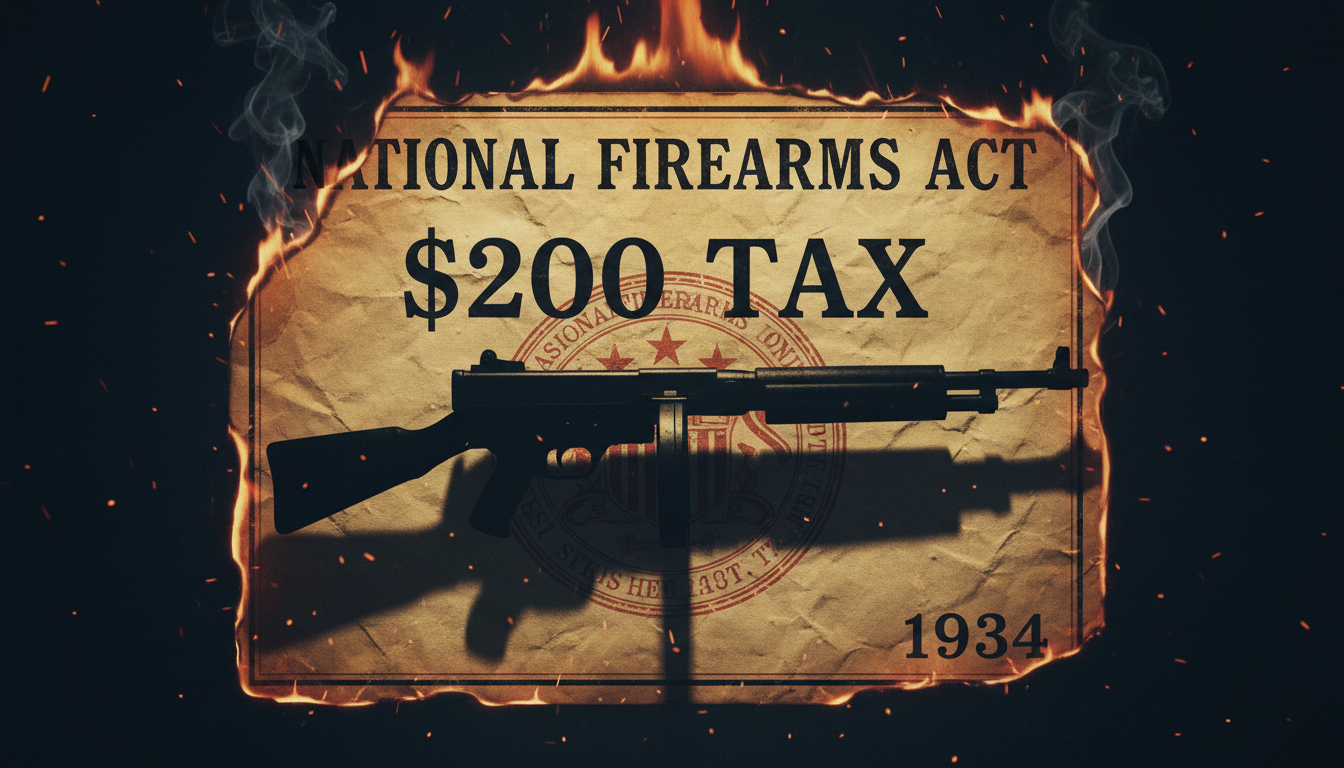 They didn’t pass the National Firearms Act to stop crime. They passed it to grow the federal government — and they used your Second Amendment rights as fertilizer.
The Crime Wave That Wasn’t
Open a history book and it’ll tell you the NFA was a response to the “gangster era.” Bonnie and Clyde. John Dillinger. Tommy guns and bank robberies. The kind of story Hollywood turned into a dozen movies.
Here’s what the history books don’t tell you: the crime wave was already over.
Prohibition ended on December 5, 1933. The homicide rate, which had peaked at 9.7 per 100,000 during the final year of the dry era, had already plummeted roughly 40% by the spring of 1934. Organized crime violence didn’t decline because of gun control. It declined because Americans could legally buy a drink again.
But Attorney General Homer Cummings and Franklin Roosevelt didn’t let a good crisis go to waste — even if they had to manufacture one.
The Play-by-Play: How They Did It
April 11, 1934. Cummings’ office introduces H.R. 9066. The bill would impose a $200 transfer tax on machine guns, silencers, sawed-off shotguns, sawed-off rifles — and handguns. Yes, handguns. Your grandfather’s revolver would have required a federal tax stamp and registration.
The NRA’s president at the time, Karl T. Frederick, showed up to the Ways and Means Committee hearings. He didn’t fight the bill. He negotiated it. Frederick helped write the machine gun definition that made it into law. He drew a hard line on pistols, and thanks to his testimony, handguns were stripped from the final version.
But Frederick wasn’t the 2A absolutist the modern NRA would recognize. His actual testimony, on the congressional record: “I have never believed in the general practice of carrying weapons. I think it should be sharply restricted and only under licenses.” The hardline NRA you know today was born in 1977 at the Revolt at Cincinnati — not 1934.
May 23, 1934: Bonnie and Clyde are gunned down in Louisiana. The NFA hasn’t even passed yet.
June 13 and 18, 1934: The House and Senate pass the bill by voice vote. No recorded vote. No roll call. Not a single member of Congress had to put their name on it.
June 26, 1934: FDR signs the National Firearms Act into law.
July 22, 1934: John Dillinger is killed by the FBI. Three weeks after the law took effect.
The NFA didn’t stop a single “public enemy.” They were already dead.
The Tax That Wasn’t About Revenue
Here’s where the story gets interesting — and by interesting, I mean infuriating.
“If we made a statute absolutely forbidding any human being to have a machine gun, you might say there is some constitutional question involved. But when you say, ‘We will tax the machine gun’… you are easily within the law.” — Attorney General Homer Cummings, congressional testimony, 1934
Let that sink in. The Attorney General of the United States admitted under oath that they couldn’t constitutionally ban these firearms. So they taxed them instead. The NFA was deliberately routed through the Ways and Means Committee — the tax committee, not the Judiciary Committee — because the whole thing was a constitutional workaround.
The $200 tax in 1934 wasn’t a fee. It was a wall. In the middle of the Great Depression, $200 equaled roughly 14% of the average American’s annual income — the equivalent of about $4,700 today. A Thompson submachine gun cost between $175 and $227 at the time. The tax was more expensive than the gun.
That was the point. It wasn’t a revenue measure. It was a prohibition disguised as a tax — because they knew a prohibition wouldn’t survive the Constitution.
The Real Goal: Registration
“Show me the man who doesn’t want his gun registered and I will show you a man who shouldn’t have a gun.” — Attorney General Homer Cummings, 1938
There it is. Registration was always the goal. Cummings and FDR didn’t just want to tax certain firearms — they wanted a federal registry of who owned what. And they used a manufactured crisis to get it.
Consider the facts they didn’t publicize:
- Congressional testimony admitted: “A thousand criminals will use pistols where one will use a machine gun.” They knew machine guns were a non-issue in crime.
- At least 28 states already had their own machine gun laws. The feds weren’t filling a gap — they were federalizing.
- The FBI literally invented the “Public Enemy No. 1” designation as a public relations tool. J. Edgar Hoover manufactured the panic he then used to expand his agency from a small investigative office into a national police force with arrest powers.
The Only Supreme Court Case Was a Sham
In 1939, the Supreme Court decided United States v. Miller — the only time the High Court has directly ruled on the NFA. Lower courts have cited it for 85 years to justify upholding the law.
Here’s what they don’t teach in law school: the defendant was dead, and nobody showed up to argue his side.
Jack Miller and Frank Layton were arrested for possessing an unregistered sawed-off shotgun. The district court dismissed the charges, ruling the NFA violated the Second Amendment. The government appealed to the Supreme Court.
Jack Miller was murdered six weeks before oral argument. No attorney appeared for the defense. The Supreme Court heard arguments from exactly one side — the federal government’s — and ruled that “in the absence of any evidence” demonstrating that a sawed-off shotgun had militia utility, they couldn’t say the Second Amendment protected it.
The Court didn’t categorically exclude short-barreled shotguns from Second Amendment protection. It said there was no evidence in the record one way or the other. Lower courts have been misreading this case for nearly a century — many of them deliberately.
The Bruen Earthquake
Then came NYSRPA v. Bruen in 2022. The Supreme Court changed everything.
The Bruen test is simple: if the Second Amendment’s plain text covers an individual’s conduct, the government must prove its regulation is “consistent with the Nation’s historical tradition of firearm regulation.” Not interest-balancing. not cost-benefit analysis. Historical tradition.
The NFA fails this test spectacularly:
- Text: The Second Amendment protects “the right of the people to keep and bear Arms.” Machine guns, suppressors, SBRs, and SBSs are all arms. The government admitted in 1934 that taxing was the only way around a ban — that’s an admission the text covers them.
- History: There were zero 18th- or 19th-century laws requiring registration of specific weapon categories. No colonial tax stamps for barrel length. No Founding-era restrictions on firearm mufflers. The NFA was invented in 1934, not 1791.
- Tradition: There is no historical tradition of specially regulating these categories of arms. The closest analogue courts can find is the NFA itself — a law passed 143 years after the Bill of Rights was ratified.
Under Bruen, a law passed in 1934 that has no analogue in the Founding era doesn’t survive. Full stop.
The Playbook: Regulatory Creep in Action
The NFA isn’t just a law. It’s a template — the original blueprint for every backdoor gun control scheme since.
When Congress won’t pass new gun control, the ATF simply redefines existing items as NFA-controlled:
- Bump stocks: ATF reclassified them as machine guns. The Supreme Court struck that down in Garland v. Cargill (2024).
- Pistol braces: ATF tried to reclassify millions of braced pistols as short-barreled rifles. Courts vacated the rule.
- Forced reset triggers: ATF attempted to reclassify them. Industry and litigation pushed back.
The pattern is clear: your legally purchased firearm becomes a federal felony overnight — not because Congress changed the law, but because a bureaucrat in Washington redefined a word.
The Hughes Amendment: Artificial Scarcity by Fiat
In 1986, Congress passed the Firearm Owners Protection Act — a generally pro-gun bill that, at the last minute, had the Hughes Amendment attached. It froze the civilian machine gun registry. No new machine guns could be registered to civilians after May 19, 1986.
The result? Only about 182,000 transferable machine guns exist for civilian purchase. Entry-level MAC-10s start around $7,000. An M16 runs $20,000 to $30,000 or more. This isn’t regulation — it’s a government-created artificial scarcity that prices the average American out of owning a category of constitutionally protected arms.
And before someone says “nobody needs a machine gun,” remember: the Second Amendment doesn’t say “the right to keep and bear arms the government thinks you need.” It says “arms.” Period.
The Modern Registry: 8.6 Million Reasons to Worry
As of 2024, the ATF’s National Firearms Registration and Transfer Record contains over 8.6 million registered items. Over 3.5 million suppressors. Nearly 870,000 short-barreled rifles. Every single one attached to a name, an address, and a federal form.
The registry has documented accuracy problems. The ATF is legally prohibited from creating a searchable electronic database of non-NFA firearms under the 1986 FOPA — but the NFA registry itself is fair game. Your tax stamp is a government record of your exercise of a constitutional right.
Why This Matters Right Now
In 2025, legislation reduced the NFA transfer tax to $0 for silencers, SBRs, SBSs, and AOWs. That sounds like a win — but it triggered a legal problem the gun control side didn’t anticipate.
The entire constitutional justification for the NFA was that it was a tax measure. Take away the tax, and you’re left with pure registration requirements with no revenue component. Three lawsuits have already been filed — Brown v. ATF, Jensen v. ATF, and Roberts v. ATF — supported by SAF, NRA, FPC, and GOA. The theory: without the tax, the NFA’s constitutional fig leaf falls away, and the registration requirements violate the Second Amendment under Bruen.
The NFA turns 91 years old this June. It was built on a media panic, passed without a recorded vote, defended by a Supreme Court case with no defense, and sold to the public as crime prevention after the crime wave had already ended.
It wasn’t constitutional in 1934. It isn’t constitutional now. And after Bruen, it may not survive much longer.
Sources: Congressional Record, 73rd Cong., 2d Sess. (1934); United States v. Miller, 307 U.S. 174 (1939); NYSRPA v. Bruen, 597 U.S. 1 (2022); District of Columbia v. Heller, 554 U.S. 570 (2008); Garland v. Cargill, 602 U.S. (2024); ATF NFA Handbook (2024); Homer Cummings and Karl T. Frederick testimony, Ways and Means Committee hearings (April-May 1934); ATF National Firearms Registration and Transfer Record; CDC Historical Homicide Statistics.
We Like Shooting
We Like Shooting is a major, long-running gun podcast and firearms media brand, broadcasting since 2013. With millions of recorded downloads, WLS brings together original gun and gear reviews, industry interviews, listener questions, and candid conversations about firearms, training, and gun culture.
You must be logged in to post a comment.