

Summary
Every gun control law you hate today hangs off one 1968 bill. The real story — racial control, the Nazi weapons law connection, the NRA's betrayal, and why Bruen is finally cracking the foundation.
 The Gun Control Act of 1968: The Law That Built the Machine
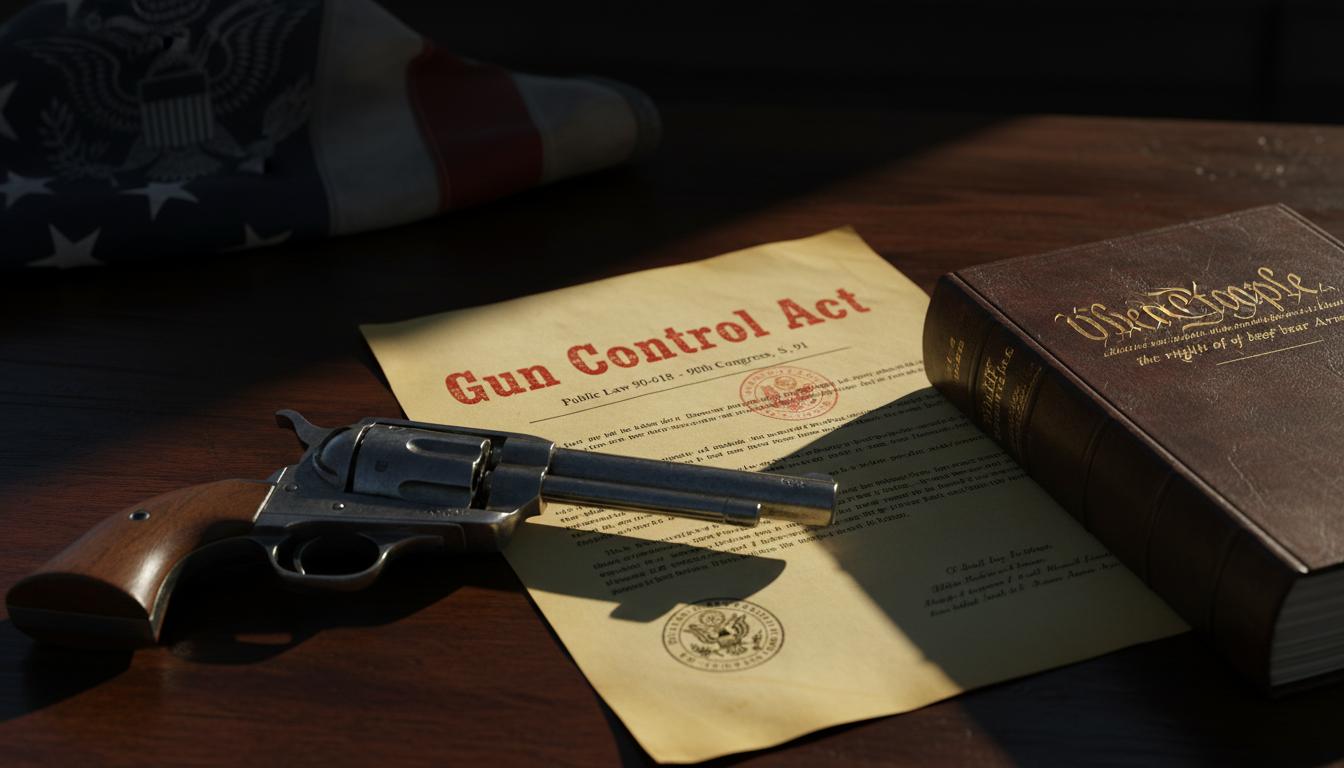
Every single gun control nightmare you deal with today traces back to one bill. One vote. One October afternoon when Lyndon Johnson signed away more of your rights than most Americans even realize.
Let me tell you about the Gun Control Act of 1968.
Not the sanitized version from your high school textbook. The real one. The one where a president exploited three assassinations to ram through legislation his own party had been sitting on for half a decade. The one where the bill’s sponsor had a Nazi weapons law translated at the Library of Congress while he was writing it. The one where the same NRA that tells you to resist today openly endorsed the whole mess.
Yeah. That one.
The Setup: How to Manufacture a Crisis
By the time LBJ put pen to paper on October 22, 1968, the country had endured four political assassinations in five years. JFK in Dallas, 1963 — shot with a mail-order Italian rifle. Malcolm X in New York, 1965. Martin Luther King Jr. in Memphis, April 4, 1968. Robert F. Kennedy in Los Angeles, June 5, 1968.
Here’s what the history books get wrong: the bill didn’t emerge from tragedy. It emerged from timing.
Senator Thomas Dodd — Democrat from Connecticut, and yes, a Nuremberg prosecutor — had introduced the first version of this legislation way back in August 1963, three months before anyone shot the President. It died in committee, because nobody wanted it badly enough to fight for it.
After JFK died, Dodd amended his bill to cover rifles and shotguns too. It died again. He introduced another version in 1965. It died. Again. And again. The legislative equivalent of a guy who keeps proposing and keeps getting turned down.
What changed wasn’t the substance of the bill. What changed was the body count.
King’s assassination on April 4, 1968 pried open a window that had been jammed shut for years. The Senate Judiciary Committee, which had been deadlocked on gun legislation for months, suddenly reported out a gun control bill as part of the Omnibus Crime Control and Safe Streets Act.
RFK’s assassination on June 5 finished the job.
The next day — June 6, 1968 — the House passed the Omnibus Act. The body was still warm. LBJ sent Congress his formal gun control proposal, and then he told his aide Joseph Califano something that tells you everything about how Washington actually works:
“We have only two weeks, maybe only 10 days before the gun lobby gets organized. We’ve got to beat the NRA into the offices of members of Congress.”
He wasn’t grieving. He was counting votes against a clock.
The Play-by-Play: Four Months That Changed Everything
What followed was one of the most concentrated legislative assaults on gun rights in American history.
May 23, 1968: Senator Russell Long of Louisiana inserts a felon possession ban (Title VII) into the Omnibus Crime Control Act by voice vote — no hearings, no debate, no analysis. Legislative sloppiness so profound that federal courts are still untangling it fifty-seven years later.
June 10: Representative Emanuel Celler introduces H.R. 17735, the standalone Gun Control Act. This is the big one.
June 11: The House Judiciary Committee deadlocks in a tie vote. LBJ throws a public tantrum, calling the deadlock “a bitter disappointment to all Americans.” Nine days later, the committee reverses itself. Presidential pressure works.
July 24: The House passes H.R. 17735, 305 to 118.
September 18: The Senate passes it 70 to 17.
October 10: The conference report passes the House 160 to 129 — much closer than the original vote, because opposition had finally organized over the August recess.
October 22, 1968: LBJ signs Public Law 90-618 into law. At the signing ceremony, he delivers what aide Joseph Califano later called “the angriest signing statement I can remember.” Johnson wasn’t celebrating. He was furious that Congress had stripped out the two provisions he wanted most: a national gun registration system and federal licensing of every single gun owner in America.
“The voices that blocked these safeguards were not the voices of an aroused nation. They were the voices of a powerful lobby, a gun lobby, that has prevailed for the moment in an election year.”
The NRA — which at this point was still primarily a marksmanship and hunting organization, years away from its 1977 Cincinnati revolt transformation — had drawn its line at registration and licensing. And on that one point, they held. Everything else, they let through.
NRA spokesman Franklin Orth called the final bill “one that the sportsmen of America can live with.”
Read that again. The NRA’s official spokesman. Said the Gun Control Act of 1968. Was something sportsmen could “live with.”
And you wonder why we don’t trust institutions.
The Hidden Truth: What They Didn’t Put in the Press Release
The Racial Control Angle
Let’s talk about what this law was actually designed to do — because it wasn’t stopping crime.
In July 1967, California Governor Ronald Reagan signed the Mulford Act, explicitly written to disarm the Black Panther Party for Self-Defense, which had been legally patrolling Oakland neighborhoods with firearms to monitor police brutality. Reagan — the same guy conservatives put on a pedestal — said he saw “no reason why on the street today a citizen should be carrying loaded weapons.” The NRA, by the way, helped draft the Mulford Act and provided notes to guide Assemblyman Don Mulford in writing it.
Less than a year later, Senator Dodd was standing on the Senate floor citing the Black Panthers’ armed protest at the California State Capitol as — quote — “a striking example of the need for effective gun control legislation.”
Robert Sherrill was an investigative reporter for the Washington Post. He supported gun control. And even he eventually admitted what the game was:
“The Gun Control Act of 1968 was passed not to control guns but to control blacks.”
Black Panther Minister of Information Eldridge Cleaver saw it coming in real time:
“Some very interesting laws are being passed. They don’t name me; they don’t say, take the guns away from us. They say that people will no longer be allowed to have guns. They don’t pass these rules specifically for black people, they have to pass them in a way that will take in everybody.”
This wasn’t conspiracy theory. This was design. The GCA banned imports of cheap handguns using a “sporting purposes” test — a provision that functionally stripped affordable self-defense tools from poor Americans, disproportionately black Americans, while leaving middle-class over-the-counter purchases untouched. Senator Joseph Tydings made the coding explicit: “It is a far different problem when a member of the Blackstone Rangers gang in a big city purchases a Saturday-night special for $5.50 than when a rural citizen… wants to purchase a gun.”
Gun control has always been about controlling the wrong people. The 1968 GCA just wrote it into federal law.
The Nazi Weapons Law Connection
Now here’s a detail that gets dismissed as conspiracy theory — except it’s not a theory. It’s documented fact.
Senator Thomas Dodd was a prosecutor at the Nuremberg trials. He had access to Nazi records, Nazi laws, Nazi legal documents. And in July 1968, while the Gun Control Act was being finalized, he walked his personal copy of the 1938 Nazi German Weapons Law over to the Library of Congress and requested a full translation.
He got it on July 12, 1968.
The Library of Congress letter still exists. You can read it. It says — verbatim — that they are enclosing “a translation of the Law on Weapons of March 18, 1938, prepared by Dr. S of that Division, as well as the Xerox copy of the original German text which you supplied.”
What does this prove? That the man writing American gun control had Nazi gun law on his desk while he was doing it. That’s it. That’s the proven fact. Whether he consciously modeled provisions on it — whether the “sporting purposes” classification, the serial number requirements, the dealer licensing system, and the prohibited persons categories were borrowed from Berlin — that’s where speculation begins. Dodd’s family has never allowed researchers access to his papers.
But the timing? The parallel provisions? You can draw your own conclusions.
The ATF Was Born Here
Most people think the Bureau of Alcohol, Tobacco, Firearms and Explosives has always existed. It hasn’t. Before 1968, firearms enforcement was a tax-collection job inside the IRS. A bureaucratic backwater. Paper-pushers collecting stamp taxes.
The Gun Control Act of 1968 changed everything. It took the Alcohol and Tobacco Tax Division, stuffed it with new firearms authority, nearly doubled its size, and transformed it into the Alcohol, Tobacco and Firearms Division — the direct predecessor to the modern ATF.
That agency now has a $1.6 billion budget, 2,572 armed special agents, and a 57-year track record of treating the Second Amendment like a regulatory nuisance. Ruby Ridge. Waco. The pistol brace rule. The zero-tolerance FFL revocation policy that ended just last year. The ghost gun redefinition. Every single one of those powers traces back to the framework Congress handed them in October 1968.
And in the same year, the Omnibus Crime Control and Safe Streets Act created the Law Enforcement Assistance Administration, which pumped $5 billion into local law enforcement — mostly for riot control equipment and SWAT teams. Not crime prevention. Control.
The Bruen Reckoning: Why This Law’s Days Are Numbered
Fast forward fifty-seven years. In 2022, the Supreme Court decided NYSRPA v. Bruen and changed everything. The new standard: the government must prove every gun law is “consistent with this Nation’s historical tradition of firearm regulation.” Not “it would be nice if fewer people had guns.” Not “this seems like common sense.” Historical tradition. Period.
And the Gun Control Act of 1968 is failing that test. Piece by piece.
In Range v. Attorney General (2024), the Third Circuit held that a Pennsylvania man convicted of food stamp fraud — a nonviolent misdemeanor — cannot be permanently stripped of his Second Amendment rights under § 922(g)(1). The court wrote: “Because the Government has not shown that our Republic has a longstanding history and tradition of depriving people like Range of their firearms, § 922(g)(1) cannot constitutionally strip him of his Second Amendment rights.”
In United States v. Connelly (2024), the Fifth Circuit struck down the prohibition on marijuana users possessing firearms — ruling that a regular marijuana user who was sober at the time of arrest had his Second Amendment rights violated. The Supreme Court is hearing United States v. Hemani on this exact question right now.
Heller’s “longstanding prohibitions” language? That was dicta. Not binding precedent. Post-Bruen, courts demand actual historical evidence — and the GCA, passed in 1968, is not “longstanding” relative to the Second Amendment ratified in 1791. There is no historical tradition of banning interstate arms commerce. No tradition of categorical dealer licensing. No tradition of disarming nonviolent offenders. The Founding generation would not recognize this regulatory scheme.
Even Justice Scalia’s landmark Heller opinion in 2008 — which gun controllers love to quote for its “presumptively lawful” language about felon prohibitions — has been reinterpreted by the courts. Post-Rahimi (2024), the dividing line is dangerousness. Laws targeting dangerous people survive. Laws targeting status categories — nonviolent felons, marijuana users, veterans with fiduciaries — are falling.
The GCA is being dismantled one provision at a time. And it can’t happen fast enough.
Why You Should Care (Spoiler: You Already Do)
If you’ve ever bought a gun online and had it shipped to an FFL for transfer — paying $25 to $100 for the privilege — that’s the GCA. The interstate handgun sales ban created the FFL middleman industry by federal fiat.
If you’ve ever been subjected to a NICS background check — the system created by the 1993 Brady Act — that system only functions because the GCA built the FFL infrastructure and the prohibited persons categories it relies on.
If you’ve ever wondered why machine guns manufactured after 1986 are illegal to civilians — the Hughes Amendment hangs off the GCA’s NFA framework.
If you’ve ever watched the ATF redefine “engaged in the business” to effectively create universal background checks without Congress voting on it — that’s regulatory creep built on the GCA’s intentionally vague statutory language.
If you’ve ever seen a veteran lose his gun rights because the VA reported him to NICS for having someone help manage his benefits — with zero judicial finding of dangerousness — that was built on the GCA’s prohibited persons framework. (Reversed February 2026, thank God, after Rep. Eli Crane exposed a thirty-year violation of veterans’ constitutional rights.)
Every gun control law you hate today — Brady checks, the machine gun ban, the assault weapons ban, the pistol brace rule, Biden’s attempted “universal background checks” — all of them hang off the framework of the 1968 Gun Control Act.
This isn’t history. This is the foundation they’re still building on.
And under Bruen, that foundation is cracking.
The Bottom Line
The Gun Control Act of 1968 was not passed to stop crime. It was passed to control who could own guns — and to build the federal enforcement apparatus to make that control stick.
Crime rates doubled in the twelve years after it became law, peaking at 10.2 homicides per 100,000 in 1980 — up from 6.9 the year LBJ signed it. If this was about public safety, it is the most expensive failure in American legislative history.
But it wasn’t about public safety. It was about building a framework — one that let the ATF grow from tax collectors into gun cops, that let Congress expand prohibited persons categories from four to nine without constitutional debate, that lets every administration “reinterpret” statutory language into new crimes without a vote.
Know the history. Because they’re still using the same playbook.
Sources: Congressional Record (H.R. 17735, S. 3633); Public Law 90-618; FBI Uniform Crime Reports; Joseph A. Califano Jr., “In tragedy, an opportunity,” Philadelphia Inquirer (Dec. 26, 2012); Robert Sherrill, The Saturday Night Special (1973); Stephen P. Halbrook, Gun Control in the Third Reich (2013); Library of Congress translation records; Range v. Attorney General, 124 F.4th 218 (3d Cir. 2024); United States v. Connelly, 117 F.4th 269 (5th Cir. 2024); NYSRPA v. Bruen, 597 U.S. 1 (2022); United States v. Rahimi, 602 U.S. 680 (2024); ATF Budget & Performance (FY2024); Congressional Research Service Reports R41206, R45629.
We Like Shooting
We Like Shooting is a major, long-running gun podcast and firearms media brand, broadcasting since 2013. With millions of recorded downloads, WLS brings together original gun and gear reviews, industry interviews, listener questions, and candid conversations about firearms, training, and gun culture.
You must be logged in to post a comment.