

 The Firearm Owners Protection Act of 1986: The Bill That “Saved Gun Rights” and Banned Your Machine Gun
On May 19, 1986, President Ronald Reagan signed the Firearm Owners Protection Act (FOPA) into law. Public Law 99-308 was supposed to be the gun rights community’s biggest legislative victory. And in a lot of ways, it was.
FOPA reined in a rogue ATF. It stopped federal agents from harassing gun dealers over paperwork errors. It made interstate rifle and shotgun sales legal again. It banned the federal government from creating a national gun registry. It gave you the right to transport firearms through anti-gun states without becoming a felon.
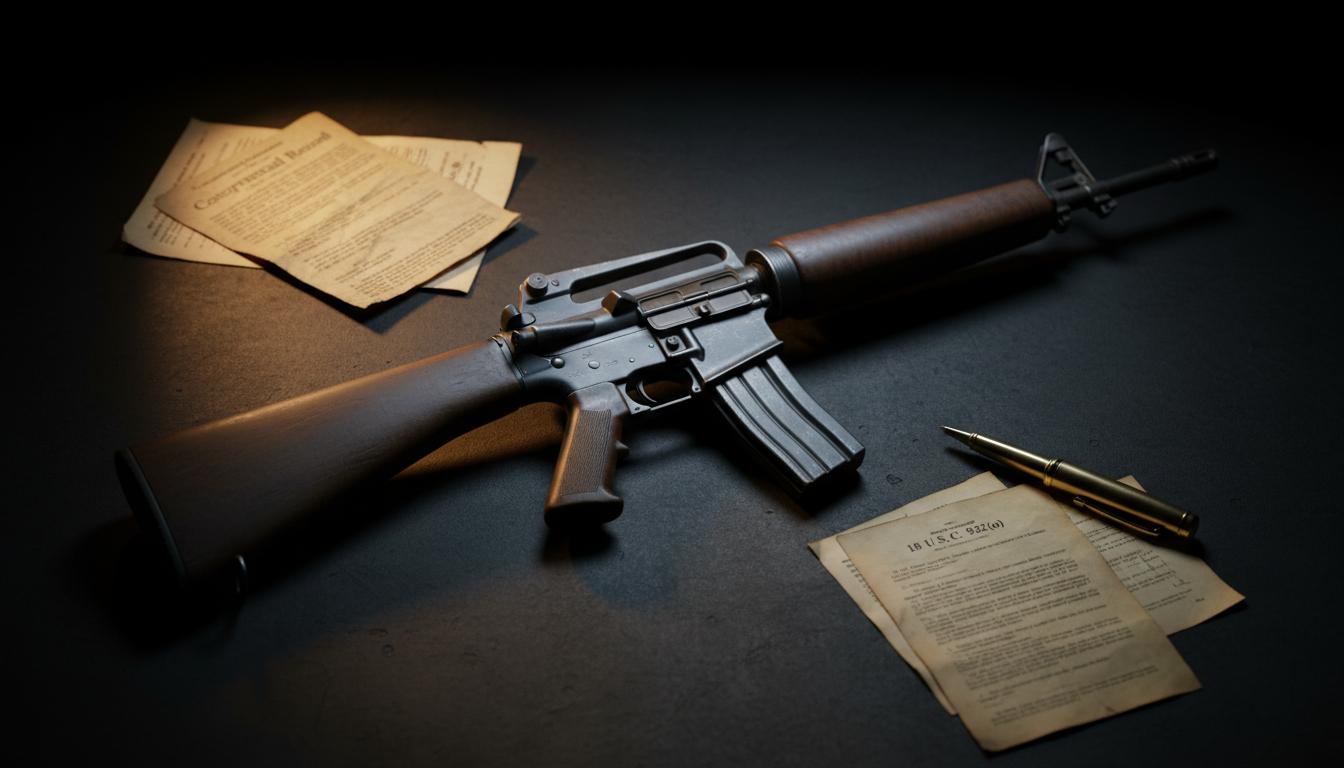
But FOPA came with a poison pill — the Hughes Amendment, which added 18 U.S.C. § 922(o) to federal law. That single paragraph made it a federal felony for any civilian to possess or transfer a machine gun manufactured after May 19, 1986.
The result? A closed registry of pre-1986 machine guns that has turned a $1,800 Colt M16 into a $30,000+ collectible. No new machine guns for civilians. Ever. For 39 years and counting.
If you care about the Second Amendment, you need to understand what happened in 1986. Because the playbook they used to ban machine guns is the same playbook they’re using on your AR-15 right now.
The ATF Was Out of Control
To understand why FOPA happened, you have to understand what the Bureau of Alcohol, Tobacco and Firearms was doing in the 1970s and early 1980s.
After the Gun Control Act of 1968, the ATF went to war against gun dealers and collectors. And they weren’t going after criminals — they were going after law-abiding Americans.
The 1982 Senate Report That Should Have Made Headlines
In February 1982, the Senate Judiciary Subcommittee on the Constitution — chaired by Orrin Hatch — released a report that should have been front-page news. It wasn’t. Here’s what they found:
- Approximately 75% of ATF gun prosecutions targeted ordinary citizens who had “neither criminal intent nor knowledge, but were enticed by agents into unknowing technical violations”
- ATF engaged in systematic entrapment operations where agents would have one agent attempt an illegal purchase, the dealer would refuse, then a second “straw man” agent would complete the purchase and charges would be filed
- ATF agents enticed gun collectors into making as few as three or four sales from personal collections, then charged them with felony “dealing without a license” carrying five-year prison sentences
- Even after acquittals, ATF “generally confiscated the entire collection” and refused to return property
Real Victims of ATF Abuse
This wasn’t abstract. These were real people:
- David Moorhead, a disabled Vietnam veteran trained as a gunsmith by the VA, was prosecuted for possessing a firearm ATF claimed was a machine gun — even though all auto-fire mechanisms had been removed and welded shut. The federal judge directed a verdict of acquittal and apologized to Moorhead on behalf of the government.
- Curtis Earl, a federally licensed NFA dealer, had 475 firearms seized after ATF’s records showed them as unregistered. He produced his original records proving every single firearm was properly registered. ATF’s records were “grossly incorrect.”
- A.W. Phillips, a Virginia dealer, secured a directed verdict of acquittal. ATF then revoked his firearms license based on exactly the charges the judge had dismissed.
The ATF had become so brazen that Rep. John Dingell — an NRA board member and Michigan Democrat — called them “a jackbooted group of fascists” in a 1981 NRA film. The campaign was so effective that Reagan proposed abolishing ATF entirely in 1981.
Something had to give. That something was FOPA.
The Hughes Amendment: How a Voice Vote Stole Your Rights
This is where the story gets ugly. And this is the part the history books leave out.
What Is the Hughes Amendment?
The Hughes Amendment — formally House Amendment 777 to H.R. 4332 — was offered by Rep. William J. Hughes (D-NJ) on April 10, 1986. It added what became 18 U.S.C. § 922(o):
“It shall be unlawful for any person to transfer or possess a machinegun.”
The only exception? Machine guns “lawfully possessed before the date this subsection takes effect.” In other words: grandfather what exists, ban everything new.
The Voice Vote That Wasn’t
Here’s where it gets interesting. And by interesting, I mean infuriating.
On April 10, 1986, the House was considering FOPA in Committee of the Whole. Debate time was running out. Hughes offered his amendment. Chairman Charlie Rangel (D-NY) called for a voice vote.
The “nays” were audibly louder.
Rangel declared “the ayes have it” anyway.
Republicans erupted. They demanded a recorded vote. After protests, a recorded vote was taken. The result: 124 Yeas, 298 Nays — the Hughes Amendment failed on a recorded vote.
Rangel ignored it. Proceeded as if it passed. The Congressional Record simply states the amendment “was agreed to.”
C-SPAN footage exists. You can watch it. The nays are louder. The recorded vote shows it lost by 174 votes. And it became law anyway.
Under the enrolled bill doctrine (Field v. Clark, 143 U.S. 649 (1892)), once a bill is signed by the presiding officers and approved by the President, courts cannot look behind the enrolled bill to question how it was passed. The irregularity is documented. The legality is unchallengeable. That’s not justice — that’s procedural malpractice with a legal seal of approval.
Timeline: How FOPA Became Law
- 1979 — NRA drafts model legislation to reform GCA ’68
- 1982 — Senate Subcommittee releases damning report on ATF abuses; Reagan proposes abolishing ATF
- July 9, 1985 — Senate passes McClure-Volkmer (S.49) 79-15 — even Joe Biden and Al Gore vote yes
- March 13, 1986 — Volkmer secures the 8th successful discharge petition in 25 years, forcing the bill out of committee
- April 10, 1986 — House substitutes FOPA for H.R. 4332, 286-136; police officers in dress uniforms protest at chamber doors
- April 10, 1986 — Hughes Amendment “passes” on fraudulent voice vote — 124-298 recorded against, ignored
- May 6, 1986 — Senate passes cleanup bill S.2414 after “backstage negotiations that tied up the Senate for hours”
- May 19, 1986 — Reagan signs FOPA into law at a private ceremony with press excluded
Reagan’s diary entry that day called the 1968 Gun Control Act “a lemon.” He didn’t mention the machine gun ban. Not once.
FOPA’s Pro-Gun Provisions: What You Actually Got
Let’s be fair. FOPA wasn’t all bad. In fact, most of it was exactly what gun owners needed.
The Good
- Banned federal firearm registration (18 U.S.C. § 926(a)): “No system of registration of firearms, firearms owners, or firearms transactions or dispositions be established.” This is why the federal government can’t keep a gun registry — though they keep trying workarounds.
- Limited ATF inspections to once per year (18 U.S.C. § 923(g)): Before FOPA, ATF could harass dealers with repeated unannounced inspections. After FOPA, one compliance inspection per year unless there’s specific criminal cause.
- Required “willful” standard for violations: The government must prove a dealer intentionally violated the law. Paperwork errors are no longer felonies.
- Interstate long gun sales: You can legally buy a rifle or shotgun from an FFL in another state, face-to-face.
- Ammunition deregulation: Eliminated ammunition dealer licensing entirely. You can buy ammo through the mail again.
- Safe transport protection (18 U.S.C. § 926A): You can drive through New York, New Jersey, or California with a firearm — unloaded and inaccessible — without becoming a felon. States hate this provision and routinely ignore it, but it’s federal law.
- 120-day forfeiture limit: ATF can’t seize your entire collection and hold it hostage for years. They have 120 days to commence proceedings.
- Attorney’s fees for prevailing parties: If the government comes after you and loses, they pay your legal bills.
The Trade
The NRA leadership called it “giving an apple to gain the orchard.” Wayne LaPierre personally called NRA EVP Warren Cassidy from Capitol Hill and said: “I want to do it. I think we have to do it.”
They traded your right to own a post-1986 machine gun for everything else in the bill. And immediately after passage, LaPierre promised that repealing the Hughes Amendment would be a “high priority.”
That promise “never went anywhere and quietly died.” Former NRA lobbyist Richard Feldman recalled having dinner with LaPierre after the House passage: “We weren’t too concerned about the machine gun issue.”
The Real Story the Media Won’t Tell You
Lie #1: “Law Enforcement Supported FOPA”
False. The Fraternal Order of Police, International Association of Chiefs of Police, Federal Law Enforcement Officers Association, and National Sheriffs’ Association all vociferously opposed FOPA. On April 10, 1986, police officers in dress uniforms literally stood in silent protest at the doors of the House chamber. It didn’t work.
Lie #2: “The Hughes Amendment Was a Last-Minute Surprise”
False. The NRA leadership knew machine guns were on the table. They accepted the trade deliberately. LaPierre and Cassidy made the call. The “surprise” narrative was political cover.
Lie #3: “The NRA Got Everything They Wanted”
False. They got most of what they wanted — and paid for it with the provision that has defined the machine gun market for 39 years. NRA hardliner Neal Knox was fired from NRA-ILA in 1982 for refusing to compromise. The “no-compromise” gun rights movement was born from this.
What the Signing Ceremony Tells You
Reagan signed FOPA at a private ceremony. Press excluded. Only bill sponsors and supporters attended — Dole, Thurmond, McClure, Volkmer, Dingell, Hatch. Sarah Brady, whose husband Jim was permanently wounded in the 1981 assassination attempt on Reagan, had personally lobbied against the bill.
When asked if Reagan had discussed the bill with Sarah Brady, White House spokesman Larry Speakes replied: “The President is certainly aware of Sarah Brady’s views.”
Political calculation outweighs personal loyalty. Every time.
The Second Amendment Angle: Bruen and the Future
Is the Hughes Amendment Constitutional?
Post-Bruen, this question is more interesting than it’s been in 40 years.
Heller (2008) explicitly stated that “weapons that are most useful in military service — M-16 rifles and the like — may be banned.” Lower courts have treated this as binding dicta. Every federal circuit to address § 922(o) post-Bruen has upheld it — Wilson (5th Cir. 2026), Bridges (6th Cir. 2025), Charles (8th Cir. 2025).
But cracks are showing:
- Judge Carlton Reeves (S.D. Miss., 2025) struck down § 922(o) in United States v. Brown
- Judge John Broomes (D. Kan., 2024) did the same in United States v. Morgan
- Both judges noted 740,000+ registered machine guns — arguably satisfying the “common use” test
- The Seventh Circuit acknowledged the circularity problem: machine guns are rare because they’re illegal
The Bruen Test Applied to Hughes
Text: “Shall not be infringed.” The Hughes Amendment is a categorical prohibition on an entire class of arms for law-abiding citizens. That looks a lot like infringement.
History: There is no Founding-era analogue for banning a category of firearms while grandfathering existing possession. The one antebellum weapon ban (Georgia, 1837) was held unconstitutional in Nunn v. State (1846).
Tradition: Machine guns were lawful for civilian purchase from 1934 to 1986 — 52 years — under the NFA. The tradition is one of heavy regulation, not categorical prohibition.
Regulatory Creep: The Template for Modern Backdoor Bans
The Hughes Amendment didn’t just ban machine guns. It proved a template that gun controllers have replicated ever since:
- Pass a law that sounds narrow (“only machine guns”)
- Cut off supply while grandfathering existing inventory
- Redefine the category through administrative interpretation — no new legislation required
- Use the sparse registry to claim the item is “unusual” in court — circular logic as legal strategy
Sound familiar?
- 1994 Federal Assault Weapons Ban: Same supply-cutoff playbook
- Bump stock ban (2018): ATF reclassified bump stocks as machine guns — the Hughes reclassification pattern applied to semi-autos
- Pistol brace rule (2023): ATF reclassified millions of pistols as short-barreled rifles
- State-level AWBs: Registration-to-confiscation playbook, proven by NYC’s 1991 registry-based demand letters and California’s retroactive SKS voiding
Every backdoor gun control scheme traces back to Hughes. FOPA fixed the ATF — and taught the gun controllers exactly how to win.
FAQ: FOPA and Machine Guns
What does FOPA stand for?
FOPA stands for the Firearm Owners Protection Act of 1986 (Public Law 99-308). It’s also known as the McClure-Volkmer Act after its primary sponsors, Sen. James McClure (R-ID) and Rep. Harold Volkmer (D-MO).
What is the Hughes Amendment?
The Hughes Amendment (18 U.S.C. § 922(o)) bans civilian possession and transfer of machine guns manufactured after May 19, 1986. Pre-1986 registered machine guns remain transferable via ATF Form 4 with a $200 tax stamp.
Can I legally own a machine gun?
Yes — if it’s a pre-1986 transferable machine gun registered in the NFRTR. You’ll need to pass an ATF background check, pay a $200 tax stamp, and wait 6-18 months for approval. Post-1986 machine guns are restricted to military, law enforcement, and certain FFL/SOT holders.
How many registered machine guns are in the U.S.?
ATF reported 741,146 legally registered machine guns as of 2021 — up from approximately 175,977 in 2016. The number has grown because the government reclassifies items and adds dealer samples, even while civilians cannot add new ones.
How many crimes have been committed with legally owned machine guns?
Two confirmed homicides since 1934. Patrolman Roger Waller (1988) and Dr. Shou Chao Ho (1992). ATF Congressional testimony has cited “less than ten crimes” total — including regulatory violations.
Can the Hughes Amendment be repealed?
Legislative repeal has been introduced in multiple Congresses but has never advanced out of committee. Post-Bruen constitutional challenges are active — United States v. Brown (S.D. Miss.) and United States v. Morgan (D. Kan.) both struck down § 922(o), though circuit courts are reviewing. A Supreme Court cert petition (Taylor v. United States, No. 25-6817) was listed for conference in March 2026.
What did FOPA actually do for gun owners?
FOPA: banned federal gun registries, limited ATF inspections to once per year, required “willful” intent for criminal violations, reopened interstate long gun sales, deregulated ammunition, protected gun owners transporting through restrictive states, and limited forfeiture to 120 days. It was the most significant pro-gun legislative victory in U.S. history — traded for a permanent machine gun ban.
Did Reagan know about the Hughes Amendment when he signed FOPA?
Reagan’s White House diary mentions only that FOPA “undoes so much of the 1968 Gun law which was a lemon.” No mention of Hughes. The signing ceremony excluded press. Whether he fully understood the implications is debated.
The Bottom Line
The Firearm Owners Protection Act of 1986 is the most consequential gun law most Americans have never heard of. It stopped a rogue ATF from destroying lives over paperwork errors. It gave gun owners protections we still rely on today — interstate sales, transport rights, ammunition deregulation, and the ban on federal registration.
But it came at a price that keeps getting steeper. The Hughes Amendment didn’t just ban machine guns. It proved that the government can eliminate an entire category of constitutionally protected arms without confiscating a single one. Cut off the supply. Let the market do the rest. Call it “compromise.”
They’re running the same play on your AR-15 right now. The only question is whether we learned anything from 1986.
Sources: 1982 Senate Judiciary Subcommittee Report (S. Doc. 2807); David Hardy, Cumberland Law Review; Congressional Record (132 Cong. Rec. H1745-H1753, April 10, 1986); Reagan Presidential Library archives; NPR/WBUR interview with Warren Cassidy (January 16, 2013); District of Columbia v. Heller, 554 U.S. 570 (2008); NYSRPA v. Bruen, 597 U.S. 1 (2022); ATF NFRTR data; United States v. Brown, 764 F. Supp. 3d 456 (S.D. Miss. 2025); United States v. Morgan (D. Kan. 2024).
You must be logged in to post a comment.